Ingredient profile
African Mango and Maca in Cinna Harmony: Seed, Root and Evidence
Maca root extract is the first and largest ingredient in Cinna Harmony's 200 mg blend, and African mango seed extract is fourth, at most 50 mg per 1 mL serving. Neither has good evidence for blood sugar. African mango's weight trials were small and poorly run, maca's dose and safety limits are unknown, and one kidney case calls for care.
Written by the Cinna Harmony editorial teamUpdated
On the label
Why are African mango and maca in Cinna Harmony?
The label does not say why. It lists "Maca (Lepidium mevenii) Root Extract" first and "African Mango (Irvingia gabonesis) Seed Extract" fourth in the proprietary blend. Both spellings are label typos for Lepidium meyenii and Irvingia gabonensis.
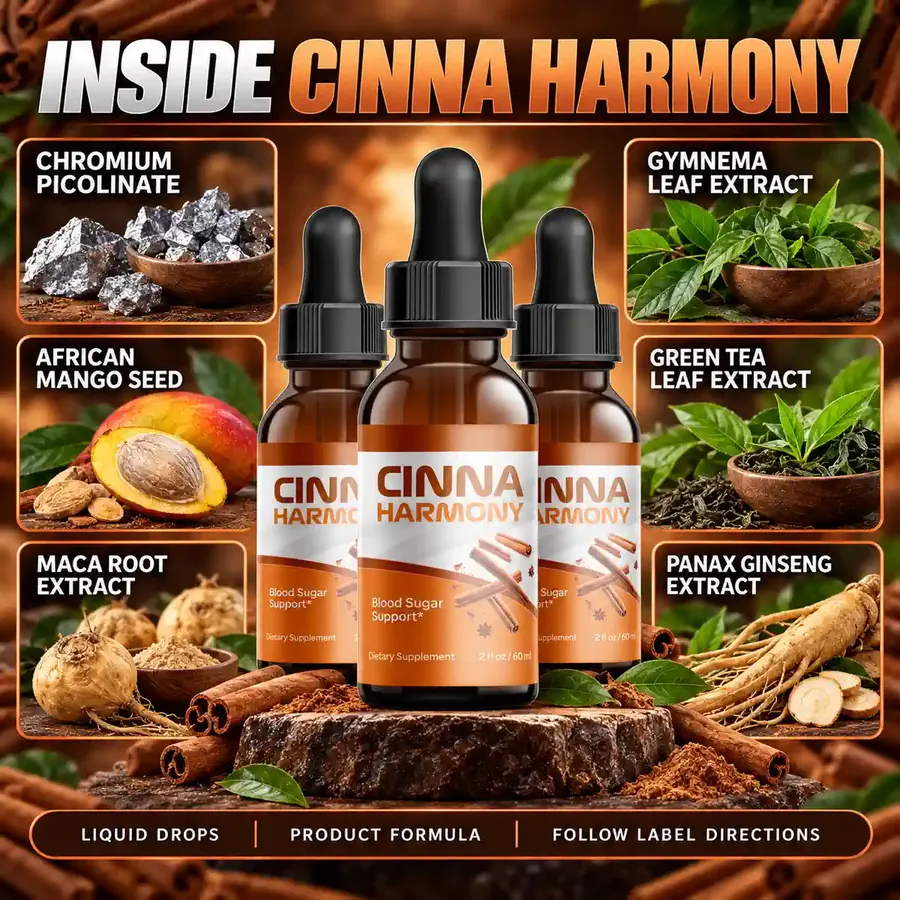
The sales page names both among its six featured ingredients (Cinna Harmony sales page, October 2026). Neither is a classic blood sugar herb. African mango is best known from weight-loss marketing. Maca is best known as an energy and libido root.
| Label name | African Mango (Irvingia gabonensis) Seed Extract, Maca (Lepidium mevenii) Root Extract |
|---|---|
| What it is | Irvingia gabonensis seed; Lepidium meyenii root |
| Type | Seed and root extracts |
| Position on the label | 4 and 1 of 22 in the blend |
| Amount per serving | Not printed (mango at most 50 mg; maca at least about 9 mg) |
| What research shows | Three small, poor-quality African mango weight trials; maca's dose and effects are not established |
| Strength of evidence | Weak |
| Why it is in the formula (brand view) | Both are named on the sales page and the ingredient graphic |
| Main caution | African mango extract was linked to kidney failure in one person with chronic kidney disease. Ask first if you have kidney disease. |
Blend math
How much maca and African mango are in each Cinna Harmony dropper?
Maca leads the list. African mango sits fourth.
- 1Maca root extract9 to 200 mg
- 2Grape seed extract0 to 100 mg
- 3Guarana seed extract0 to 67 mgA natural caffeine source; caffeine amount not printed
- 4African mango seed extract0 to 50 mg
- 5Eleuthero root extract0 to 40 mg
- 6Astragalus root extract0 to 33 mg
- 7Green tea leaf extract0 to 29 mgAlso contains caffeine
- 8Gymnema leaf extract0 to 25 mgThe herb most tied to blood sugar claims
- 9Coleus forskohlii root extract0 to 22 mg
- 10Capsicum (pepper) fruit extract0 to 20 mg
- 11Grapefruit fruit extract0 to 18 mg
- 12Panax ginseng aerial extract0 to 17 mgLeaf and stem, not root
- 13Raspberry ketones0 to 15 mg
- 14L-glutamine0 to 14 mg
- 15L-tyrosine0 to 13 mg
- 16L-arginine base0 to 12 mg
- 17Beta-alanine0 to 12 mg
- 18Monoammonium glycyrrhizinate (licorice)0 to 11 mg
- 19GABA0 to 11 mg
- 20L-ornithine HCl0 to 10 mg
- 21L-tryptophan0 to 9.5 mg
- 22L-carnitine base0 to 9.1 mg
- ?Cinnamon0 mgNot one of the 22. The name suggests it; the list does not include it.
Blend ingredients are listed from heaviest to lightest (FDA, Labeling guide), so the ingredient in place k can weigh at most 200 ÷ k mg per serving. That is our math from the label, not a lab test. Chromium sits outside the blend with its own amount: 0.7 mcg.
Blend ingredients run heaviest first (FDA, Labeling guide). Maca, in first place, must weigh at least the 9 mg average, and it is likely the biggest single share. African mango, in fourth place, can weigh no more than 200 divided by 4, or 50 mg per serving. If a dropper holds about 1 mL (our assumption, since the label does not say), 2 droppers a day means at most 100 mg of African mango.
Research check
What does research say about African mango and maca?
Both have thin research, and none of it is about blood sugar.
| Question | African mango (seed) | Maca (root) |
|---|---|---|
| Main research topic | Weight loss: 3 small trials, 208 people (Onakpoya, J Diet Suppl 2013) | Sexual function: evidence limited (MSKCC, Maca) |
| Trial quality | None reported proper randomization or concealment (Onakpoya, J Diet Suppl 2013) | No glucose trials in our sources |
| Known dose | Not established in our sources | Therapeutic dose unknown (MSKCC, Maca) |
| Known safety flag | Kidney failure in one person with kidney disease (NIH ODS, Weight loss supplements) | Toxicity unknown (MSKCC, Maca) |
| Amount per 1 mL serving | At most 50 mg | At least about 9 mg |
African mango
Does African mango help with weight or blood sugar?
There is no good proof for either. A systematic review found three small trials, all in people of African origin, that reported more weight loss than placebo (Onakpoya, J Diet Suppl 2013). None of the trials described proper randomization or an intention-to-treat analysis.
The reviewers concluded that African mango "could not be recommended as a weight loss aid" until better trials show it works (Onakpoya, J Diet Suppl 2013). Our sources contain no trial of African mango for blood sugar. No trial has tested Cinna Harmony either, and the ADA does not recommend herb supplements for blood sugar (ADA, Standards of Care 2026).
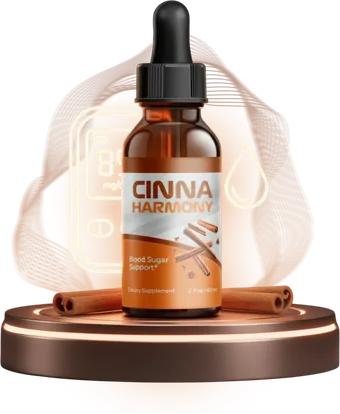
Try Cinna Harmony, 1 or 2 droppers a day2, 3 or 6 bottles · free US shipping on 3 and 6 · 60-day guarantee
Order nowMaca
What is maca root, and what does it do?
Maca is a root grown high in the Andes. In supplements it is sold for energy and sexual health. Memorial Sloan Kettering says the evidence for sexual function is limited, and maca does not change levels of hormones such as testosterone or estradiol in people (MSKCC, Maca).
MSKCC also says maca's therapeutic dose and its toxicity are unknown. So even though maca is the largest share of the Cinna Harmony blend, nobody can say what a useful or a risky amount would be.
Safety
Who should be careful with African mango?
People with kidney disease should ask before using it. The NIH Office of Dietary Supplements notes a case of kidney failure linked to African mango extract in a patient with chronic kidney disease (NIH ODS, Weight loss supplements).
If you have kidney disease, or your clinician watches your kidney numbers, ask first. Bring the bottle so they can read the full list.
The label also asks anyone with a known medical condition, and anyone pregnant or nursing, to consult a physician first. The full list of reactions is on the side effects page.
Other ingredients
What comes after maca and African mango in the blend?
Between them sit grape seed (2nd) and guarana (3rd). After African mango come eleuthero, astragalus, green tea and gymnema. Read every line on the Supplement Facts page, or see how the brand's claims hold up on the claims and evidence page.
FAQ
African mango and maca in Cinna Harmony: common questions
How much maca is in Cinna Harmony?
The label does not print it. Maca is listed first in the 200 mg blend, so it is the largest share and weighs at least the 9 mg average per 1 mL serving. Its exact amount, and any standard for the extract, are not published.
Does African mango lower blood sugar?
Our sources show no trial of African mango for blood sugar. Its research is about weight, and a review of three small, poorly reported trials said it could not be recommended even for weight loss. No study has tested Cinna Harmony for any effect.
Is African mango safe for your kidneys?
Most people may have no trouble, but one case links it to harm. The NIH Office of Dietary Supplements notes kidney failure in a patient with chronic kidney disease who took African mango extract. If you have kidney disease, ask your clinician first.
What is maca root good for?
Maca is sold for energy and sexual health, but the evidence is limited. Memorial Sloan Kettering says it does not change hormone levels in people and that its useful dose and its toxicity are unknown. It has no proven blood sugar role.
Why does the Cinna Harmony label say Lepidium mevenii?
It is a typo. The maca plant is Lepidium meyenii. The same label also prints Irvingia gabonesis for African mango, which is correctly spelled Irvingia gabonensis. Typos do not change what is in the bottle, but they are worth knowing when you search.
Will Cinna Harmony help me lose weight?
The label does not claim weight loss, and no trial of Cinna Harmony exists. African mango has weak weight research, and the amount here is at most 50 mg per serving. A lifestyle program with modest weight loss has far stronger evidence.
Who wrote this
Written and reviewed by
Plain-language pages built from the label, the sales page and linked public health sources.
Last updated . Read our editorial standards and how we check reviews. This website is run by Cinnaharmonys, a USA Authorized Cinna Harmony Retailer, not by the manufacturer. We earn money when you buy through our order links.
Keep reading
More about Cinna Harmony
Ingredients
All 23 active ingredients and the nine others, in label order, with the blend math and the missing cinnamon.
Read more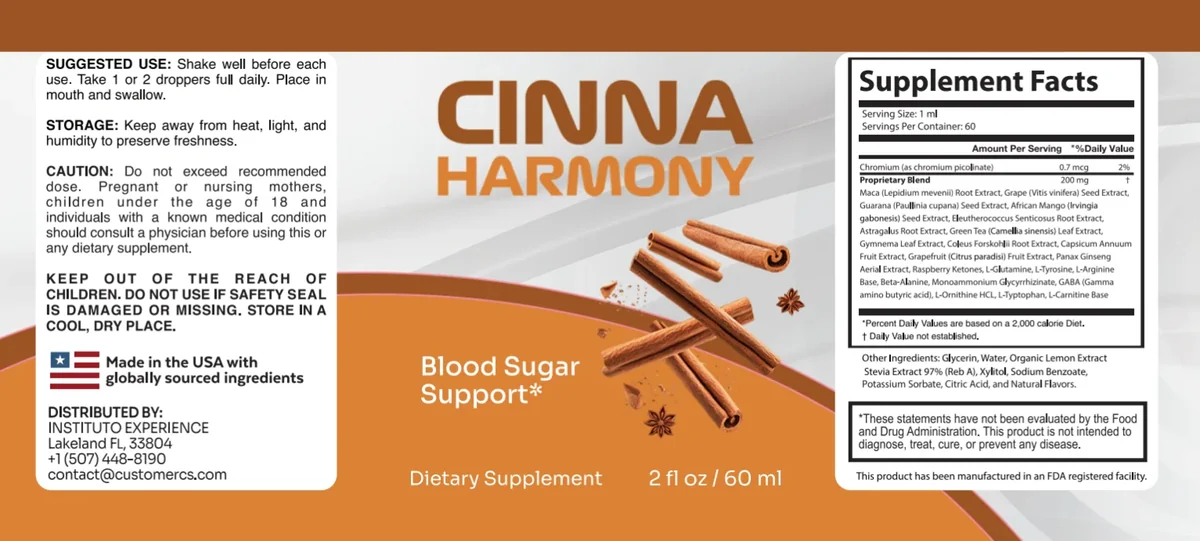
Supplement Facts
Every line of the Cinna Harmony label typed out, with the blend math, the typos and what the label leaves out.
Read moreClaims and evidence
Each benefit the brand claims, set next to the label and the research behind it.
Read moreUSA Authorized Cinna Harmony Retailer
Ready to try Cinna Harmony?
Pick a pack on the sales page. 1 or 2 droppers a day, 30 to 60 days per bottle. Guarantee: 60 days from purchase.
- Order on the sales page
- 60 days from purchase
- Label email: [email protected]