Name vs label
Cinna Harmony Name vs Label: The Cinnamon That Is Not There
The name "Cinna Harmony" and the cinnamon sticks and star anise on the front suggest cinnamon, but the label lists none. Chromium, the 22 blend ingredients and the 9 other ingredients leave out both, and the sales page does not name cinnamon either. Cinnamon's own mixed research used about 2 g a day, so none of it applies to this bottle.
Written by the Cinna Harmony editorial teamUpdated
Try it
Is there any cinnamon on the Cinna Harmony label?
None. The search box starts on "cinnamon" and finds zero matches. Try "anise" or "bark" too.
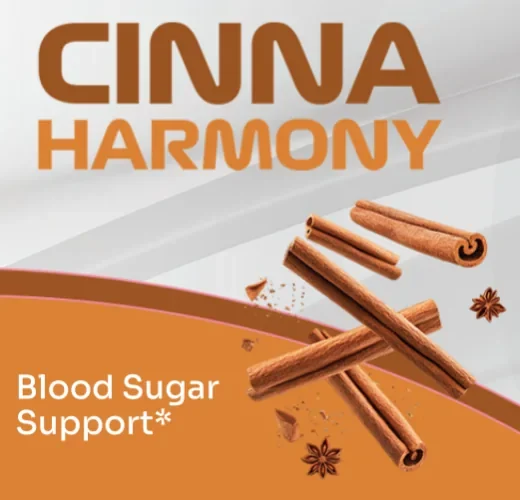
- The name“CINNA” HarmonySuggests: CinnamonNot listed
- The front artCinnamon sticksSuggests: Cinnamon barkNot listed
- The front artStar anise podsSuggests: Star aniseNot listed
- The front claim“Blood Sugar Support”Suggests: A blood sugar effectNo trial of this product
- Chromium (as chromium picolinate)
- Maca root extract
- Grape seed extract
- Guarana seed extract
- African mango seed extract
- Eleuthero root extract
- Astragalus root extract
- Green tea leaf extract
- Gymnema leaf extract
- Coleus forskohlii root extract
- Capsicum (pepper) fruit extract
- Grapefruit fruit extract
- Panax ginseng aerial extract
- Raspberry ketones
- L-glutamine
- L-tyrosine
- L-arginine base
- Beta-alanine
- Monoammonium glycyrrhizinate (licorice)
- GABA
- L-ornithine HCl
- L-tryptophan
- L-carnitine base
- Glycerin
- Water
- Organic lemon extract
- Stevia extract 97% (Reb A)
- Xylitol
- Sodium benzoate
- Potassium sorbate
- Citric acid
- Natural flavors
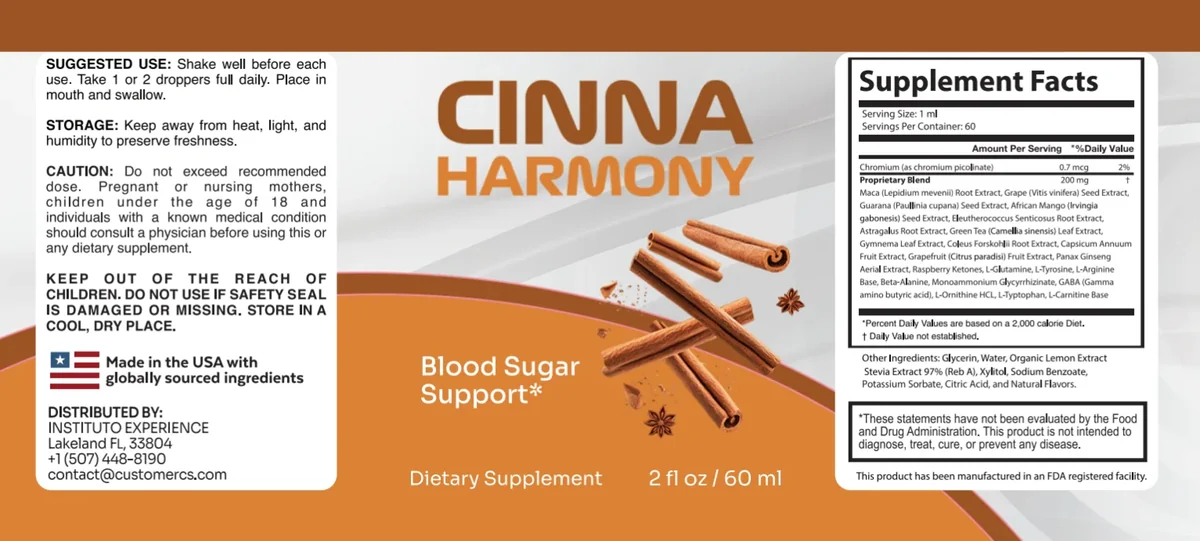
0 matches for “cinnamon”. Not in the Supplement Facts, not in the Other Ingredients.
A food name that suggests only some of its ingredients may be misleading under FDA rules (21 CFR 101.18(b); whether that applies to this product is FDA's call, not ours. We simply report what the label lists. The search runs only on your screen.
The label has 32 ingredient lines. None is cinnamon, cinnamon bark or star anise. The sales page names six ingredients, and cinnamon is not one of them (Cinna Harmony sales page, October 2026).
Brand graphic
Why does Cinna Harmony look like a cinnamon product?
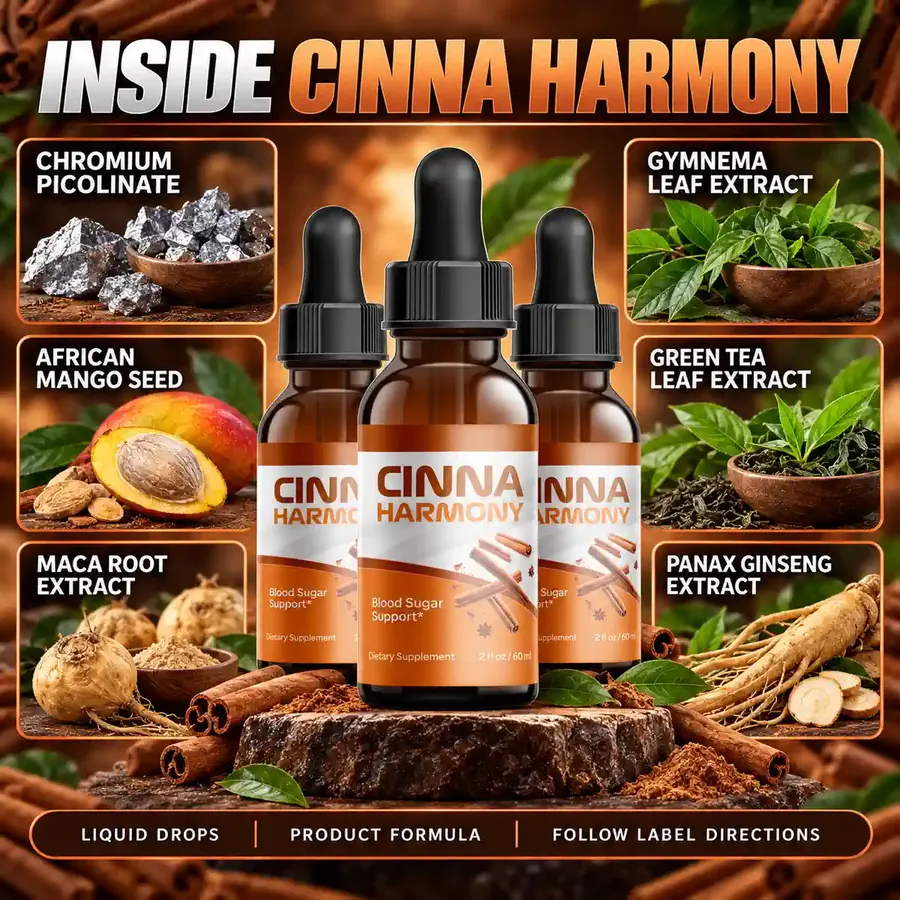
The name opens with "Cinna," and the label art shows cinnamon sticks and star anise. The brand's "Inside Cinna Harmony" graphic adds cinnamon sticks and powder around six ingredient tiles. All six tiles are on the label; the cinnamon is a prop.
The name and the art suggest cinnamon; the label lists none.
The image has a second gap. Its ginseng tile shows a root, but the label lists "Panax Ginseng Aerial Extract": leaf and stem. Blood sugar data on leaf and stem come only from animal and test-tube studies (Wang et al., Chin Med 2009).
What is there instead
What is in Cinna Harmony instead of cinnamon?
A trace of chromium and a 200 mg blend split 22 ways. The chart shows the most each one could weigh.
- 1Maca root extract9 to 200 mg
- 2Grape seed extract0 to 100 mg
- 3Guarana seed extract0 to 67 mgA natural caffeine source; caffeine amount not printed
- 4African mango seed extract0 to 50 mg
- 5Eleuthero root extract0 to 40 mg
- 6Astragalus root extract0 to 33 mg
- 7Green tea leaf extract0 to 29 mgAlso contains caffeine
- 8Gymnema leaf extract0 to 25 mgThe herb most tied to blood sugar claims
- 9Coleus forskohlii root extract0 to 22 mg
- 10Capsicum (pepper) fruit extract0 to 20 mg
- 11Grapefruit fruit extract0 to 18 mg
- 12Panax ginseng aerial extract0 to 17 mgLeaf and stem, not root
- 13Raspberry ketones0 to 15 mg
- 14L-glutamine0 to 14 mg
- 15L-tyrosine0 to 13 mg
- 16L-arginine base0 to 12 mg
- 17Beta-alanine0 to 12 mg
- 18Monoammonium glycyrrhizinate (licorice)0 to 11 mg
- 19GABA0 to 11 mg
- 20L-ornithine HCl0 to 10 mg
- 21L-tryptophan0 to 9.5 mg
- 22L-carnitine base0 to 9.1 mg
- ?Cinnamon0 mgNot one of the 22. The name suggests it; the list does not include it.
Blend ingredients are listed from heaviest to lightest (FDA, Labeling guide), so the ingredient in place k can weigh at most 200 ÷ k mg per serving. That is our math from the label, not a lab test. Chromium sits outside the blend with its own amount: 0.7 mcg.
Blend ingredients are listed heaviest first (FDA, Labeling guide). So the one in place k weighs at most 200 divided by k mg. Gymnema sits eighth, at most 25 mg. That is our math, not a lab test. Line by line detail is on the Supplement Facts page.
Cinnamon research
What does research say about cinnamon and blood sugar?
Mixed and hard to read. And every study below tested cinnamon, which this bottle does not list.
| Source | What it looked at | What it found |
|---|---|---|
| NCCIH fact sheet (NCCIH, Cinnamon) | Overall evidence on cinnamon | Results are hard to interpret; unclear whether it helps diabetes |
| Cochrane review, 2012 (Cochrane, Leach and Kumar 2012) | 10 trials, 577 adults, mostly cassia at about 2 g a day | Insufficient evidence; no significant change in A1C |
| Allen et al., 2013 (Allen et al., Ann Fam Med 2013) | 10 trials, 543 people with type 2 diabetes | Fasting glucose about 25 mg/dL lower; no significant A1C change |
| Meta-analysis, 2024 (Phytother Res 2024 meta-analysis) | 24 trials in type 2 diabetes | Lower fasting glucose and A1C in standardized units, not mg/dL; the abstract may contain a reporting error |
Most trials used about 2 g of cinnamon a day. If a dropper holds about 1 mL, 2 droppers give about 400 mg of blend a day. That covers all 22 ingredients, and 0 mg of it is cinnamon.
Try Cinna Harmony, 1 or 2 droppers a day2, 3 or 6 bottles · free US shipping on 3 and 6 · 60-day guarantee
Order nowThe labeling rule
Can a supplement name suggest an ingredient that is not inside?
FDA rules speak to it. Under 21 CFR 101.18(b), a food name that suggests only some of its ingredients may be misleading (21 CFR 101.18(b). That holds even when all ingredients are listed elsewhere. Dietary supplements are regulated as a category of food.
That rule talks about names, not pictures. Whether it applies to "Cinna Harmony" is FDA's call, not ours.
For how to read past any product name to its Supplement Facts, see the article on names that do not match the label.
If you came for cinnamon
What should I do if I wanted a cinnamon supplement?
Know what you are buying, and talk it over with your clinician first.
Check the Supplement Facts
A cinnamon product should list cinnamon with an amount. A name or a picture is not an amount.
Look for the type
Cassia is the most common type sold in North America; Ceylon is the other. Many products do not say which (NCCIH, Cinnamon).
Ask about coumarin
Cassia contains coumarin. Some cassia products are high in it, and long use could matter for people with liver disease (NCCIH, Cinnamon).
Keep your plan
The ADA's 2026 Standards do not recommend herb or spice supplements for blood sugar benefit (ADA, Standards of Care 2026). A supplement is an add-on question for your clinician, never a swap for prescribed care.
Fair view
Does the missing cinnamon make Cinna Harmony a bad product?
Not by itself. The label is honest about what it holds: it prints every ingredient in weight order and shows the chromium amount as required. The gap is between that list and the name and art on the same bottle.
The bigger questions are elsewhere: no trial of Cinna Harmony exists and the blend amounts are hidden. Our buyer's check weighs those next to the real strengths.
FAQ
Cinna Harmony cinnamon and name FAQ
Is there cinnamon in Cinna Harmony?
None is listed. The Supplement Facts and the Other Ingredients name 32 lines, and cinnamon is not one of them. The name, the cinnamon sticks and star anise on the front and the brand's graphics suggest it, but the label is what lists the contents.
Where does the name Cinna Harmony come from?
The sales page does not explain the name. The name and the label art suggest cinnamon, while the label lists none. FDA rules address names that suggest only some ingredients; whether that applies here is FDA's call.
Can cinnamon research tell me if Cinna Harmony works?
No. Cinnamon trials tested about 2 g of cinnamon a day, and this bottle lists none. Their results were mixed anyway: a Cochrane review found insufficient evidence and no A1C change.
What is the main ingredient in Cinna Harmony?
Maca root extract is listed first in the 200 mg blend, so it is the largest share. The label prints no single amounts, only the blend total. Chromium is the one ingredient with a printed amount, 0.7 mcg per 1 mL serving, 2% of the Daily Value.
Is the Cinna Harmony name misleading?
The name and front art point to cinnamon and the label lists none, which readers can check for themselves. Whether that meets the FDA standard for a misleading name is a legal question for FDA. We report the label and leave the ruling to the regulator.
Should I add cinnamon to Cinna Harmony myself?
Ask your clinician before adding any supplement. Cinnamon's blood sugar evidence is unclear, and cassia can be high in coumarin. NCCIH says cinnamon in normal food amounts is likely safe.
Who wrote this
Written and reviewed by
Plain-language pages built from the label, the sales page and linked public health sources.
Last updated . Read our editorial standards and how we check reviews. This website is run by Cinnaharmonys, a USA Authorized Cinna Harmony Retailer, not by the manufacturer. We earn money when you buy through our order links.
Keep reading
More about Cinna Harmony
Supplement Facts
Every line of the Cinna Harmony label typed out, with the blend math, the typos and what the label leaves out.
Read moreCinnamon research
Four reviews of cinnamon and blood sugar, read plainly, plus the one fact that matters for Cinna Harmony.
Read more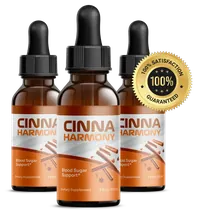
Is it legit?
A plain check of the label, the seller, the guarantee and the evidence: what is real and what is missing.
Read moreUSA Authorized Cinna Harmony Retailer
Ready to try Cinna Harmony?
Pick a pack on the sales page. 1 or 2 droppers a day, 30 to 60 days per bottle. Guarantee: 60 days from purchase.
- Order on the sales page
- 60 days from purchase
- Label email: [email protected]