Label reading
Does Cinna Harmony Have Cinnamon? Read the Label Past the Name
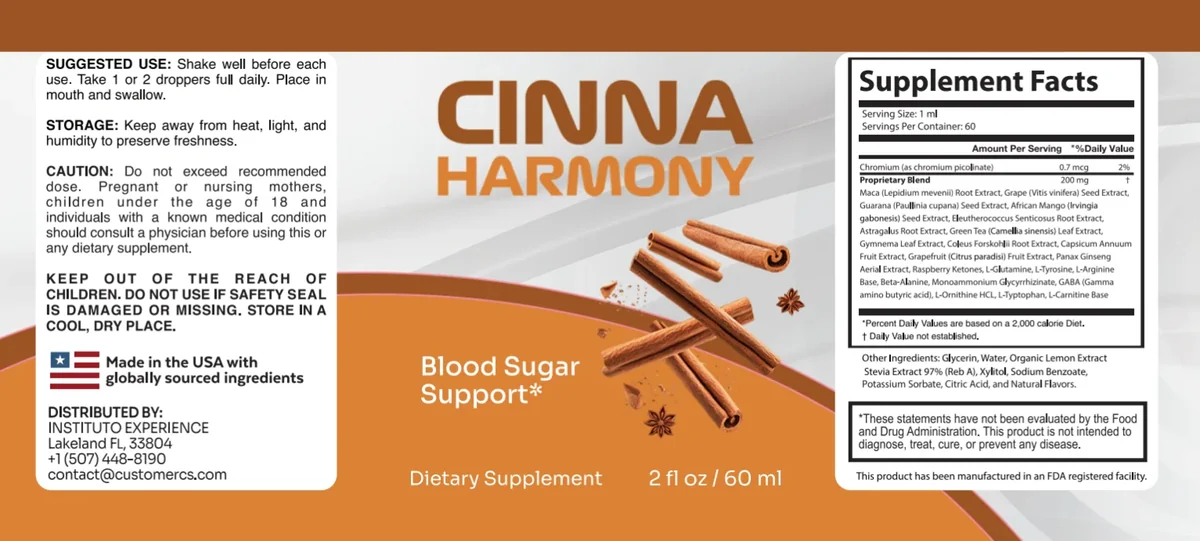
Does Cinna Harmony contain cinnamon? The name and the cinnamon sticks on the label suggest it, yet none of its 32 ingredient lines lists cinnamon. A product name and front art are branding. The Supplement Facts and Other Ingredients are the list that counts, so read that panel first.
Written by the Cinna Harmony editorial teamUpdated · 8 min read
The basics
Can a supplement name suggest an ingredient that is not inside?
Yes. A brand name, a tagline or a drawing on the front can point to an ingredient that the ingredient list never mentions. The front sells; the panel informs.
Every supplement carries a Supplement Facts panel. Nutrients with a Daily Value, such as chromium, must appear with their own amounts. Blend ingredients sit under the blend's total weight, listed heaviest first (FDA, Labeling guide). Anything else goes under Other Ingredients. If a name is not on those lists, it is not in the bottle as an ingredient.
A real example
What does the Cinna Harmony label show about cinnamon?
The name and the art say cinnamon. Search the label lines yourself.
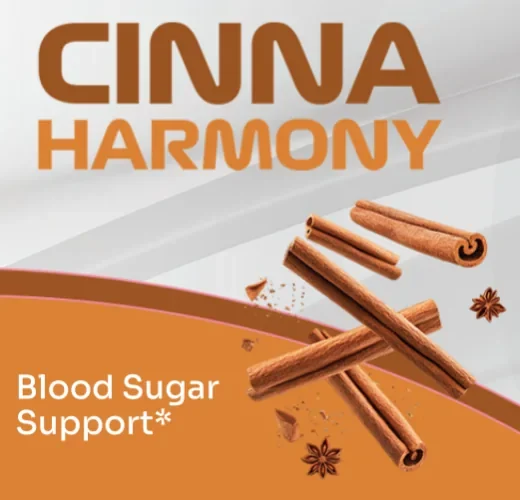
- The name“CINNA” HarmonySuggests: CinnamonNot listed
- The front artCinnamon sticksSuggests: Cinnamon barkNot listed
- The front artStar anise podsSuggests: Star aniseNot listed
- The front claim“Blood Sugar Support”Suggests: A blood sugar effectNo trial of this product
- Chromium (as chromium picolinate)
- Maca root extract
- Grape seed extract
- Guarana seed extract
- African mango seed extract
- Eleuthero root extract
- Astragalus root extract
- Green tea leaf extract
- Gymnema leaf extract
- Coleus forskohlii root extract
- Capsicum (pepper) fruit extract
- Grapefruit fruit extract
- Panax ginseng aerial extract
- Raspberry ketones
- L-glutamine
- L-tyrosine
- L-arginine base
- Beta-alanine
- Monoammonium glycyrrhizinate (licorice)
- GABA
- L-ornithine HCl
- L-tryptophan
- L-carnitine base
- Glycerin
- Water
- Organic lemon extract
- Stevia extract 97% (Reb A)
- Xylitol
- Sodium benzoate
- Potassium sorbate
- Citric acid
- Natural flavors
0 matches for “cinnamon”. Not in the Supplement Facts, not in the Other Ingredients.
A food name that suggests only some of its ingredients may be misleading under FDA rules (21 CFR 101.18(b); whether that applies to this product is FDA's call, not ours. We simply report what the label lists. The search runs only on your screen.
Cinna Harmony opens with "Cinna," and its label shows cinnamon sticks and star anise. Its panel lists chromium, 22 blend ingredients and nine other ingredients. Neither cinnamon nor star anise appears, and the sales page does not name cinnamon as an ingredient either (Cinna Harmony sales page, October 2026). The full story is on the name versus label page.
The rules
What do federal rules say about names that suggest an ingredient?
One food rule speaks to it directly. Under 21 CFR 101.18(b), a food with two or more ingredients may be misleading if its name includes or suggests some ingredients but not all of them, even when the full list appears elsewhere (21 CFR 101.18(b).
Two limits matter. The rule does not mention pictures. And while dietary supplements are regulated as a kind of food, whether it applies to any given product name is FDA's decision, not ours or yours. What a shopper can do is simpler: compare the name to the panel and decide with the facts.
Five-minute check
How do you check a supplement name against its label?
Match each front-of-pack promise to a line on the back.
| What the front shows | Where to check | What to look for |
|---|---|---|
| An ingredient in the name | Supplement Facts and Other Ingredients | The same ingredient, by name, on either list |
| Pictures of plants or spices | The same two lists | Each pictured item named somewhere; art alone proves nothing |
| "Proprietary blend" | The blend line | Total weight, number of ingredients and their order |
| A headline nutrient | Its own line | Amount in mcg or mg and the % Daily Value |
| A dose or "use daily" | Serving size and directions | How much one serving is and how many a day |
Run the same check on Cinna Harmony and the gaps show quickly: chromium is 0.7 mcg, 2% of the Daily Value, and the 200 mg blend gives no single amounts. Every line is typed out on the Supplement Facts page.
Try Cinna Harmony, 1 or 2 droppers a day2, 3 or 6 bottles · free US shipping on 3 and 6 · 60-day guarantee
Order nowBrand graphics
Can brand graphics add ingredients the label leaves out?
They can suggest them. Ingredient tiles, spice props and plant photos are design choices. Read them as mood, then go back to the panel.
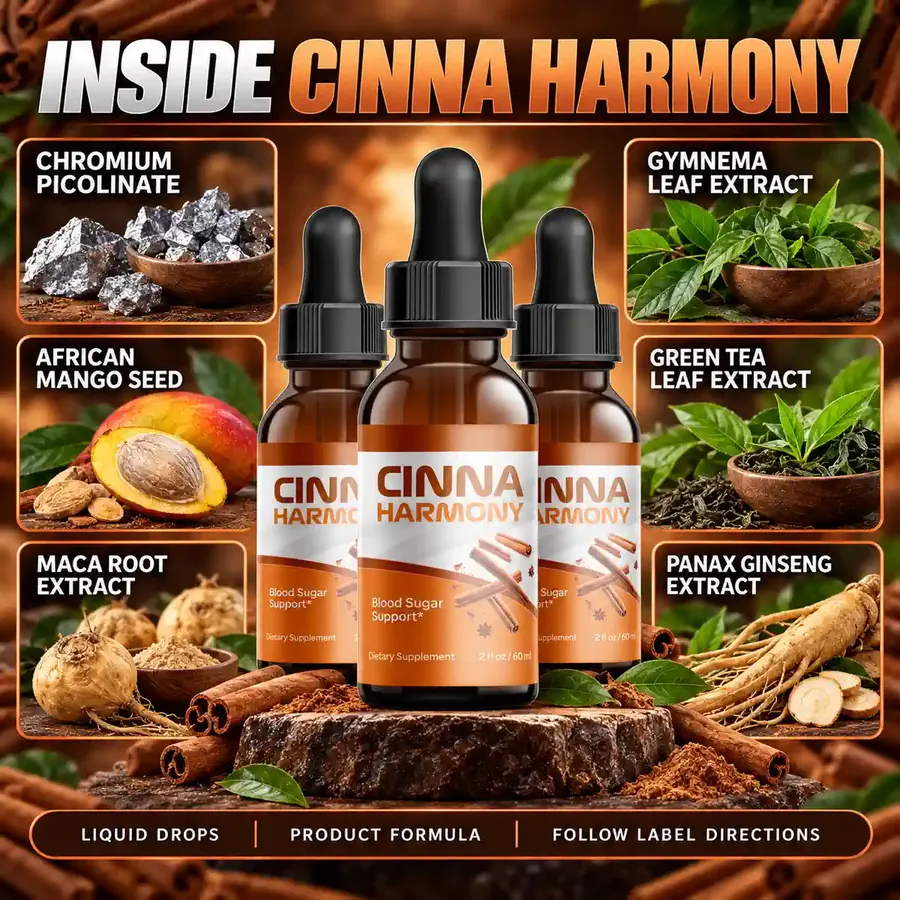
Cinna Harmony's "Inside" graphic shows six real label ingredients, ringed by cinnamon sticks and cinnamon powder. The cinnamon is decoration. The ginseng pictured is a root, yet the label lists Panax ginseng "aerial" extract: leaf and stem (Wang et al., Chin Med 2009).
- Count the tiles against the panel.
- Check the plant part: root, leaf, seed or fruit.
- Ignore props that no label line names.
Evidence
Why does research on a named ingredient not carry over?
Because a study only describes what was in the study. Cinnamon is a good case. Its trials mostly used about 2 g a day of cassia (Cochrane, Leach and Kumar 2012), and the results are mixed: NCCIH calls the benefit for diabetes unclear (NCCIH, Cinnamon). None of it applies to a bottle that lists no cinnamon.
The same logic holds when an ingredient is present but tiny. Gymnema's typical dose is 400 mg three times a day (LiverTox, Gymnema); in Cinna Harmony it is eighth in a 200 mg blend, so at most 25 mg per serving. FTC guidance says health claims need studies that match the product's dose and formula (FTC, Health Products Compliance Guidance). The cinnamon research itself is reviewed in our cinnamon research article.
What to do
What should you do if you wanted the named ingredient?
Find it on a panel
Pick a product whose label names the ingredient with its own amount.
Check the type
For cinnamon, cassia and Ceylon differ, and cassia contains coumarin (NCCIH, Cinnamon).
Ask first
With liver disease or diabetes medicines, talk to your clinician before you start.
FAQ
Supplement names and labels: common questions
Can a supplement be named after an ingredient it does not contain?
It happens. A name or front picture can suggest an ingredient the panel never lists. A federal food rule says such a name may be misleading, but whether it applies to a given supplement is FDA's decision. As a shopper, trust the Supplement Facts and Other Ingredients over the name.
Where is the real ingredient list on a supplement bottle?
It is in the Supplement Facts panel and the Other Ingredients line right below it. Nutrients with a Daily Value get their own amounts, blend ingredients are listed heaviest first under the blend weight, and everything else appears under Other Ingredients. The front of the bottle is not the list.
Why does the Cinna Harmony label show cinnamon sticks?
The brand has not explained the art. What the label does show is clear: not one of its 32 ingredient lines lists cinnamon or star anise, and the sales page does not name cinnamon as an ingredient. Treat the sticks as decoration and read the panel for what is inside.
Do pictures on a supplement label have to match the ingredients?
The food rule on names, 21 CFR 101.18(b), does not mention pictures. Whether any image misleads is a question for FDA, not shoppers. The practical answer is to check every pictured plant or spice against the ingredient list before you rely on it.
What does proprietary blend mean on a supplement label?
It is a group of ingredients sold under one total weight. FDA requires the blend weight and the ingredient names in order of weight, heaviest first, but not each amount. In Cinna Harmony, 22 ingredients share 200 mg, about 9 mg each on average.
Does the order of ingredients on a supplement label matter?
Yes. Inside a blend, ingredients run from most to least by weight. That sets a ceiling: the eighth item in a 200 mg blend can weigh at most 25 mg. Ingredients near the end of a long list are usually present in very small amounts.
How do I choose a cinnamon supplement if that is what I want?
Look for a label that lists cinnamon by name, with an amount and ideally the type, cassia or Ceylon. NCCIH says its benefit for diabetes is unclear, and cassia contains coumarin, a concern for people with liver disease. Ask your clinician before you start, especially with diabetes medicines.
Does the Cinna Harmony label list cinnamon as an ingredient?
No. None of the 32 ingredient lines on the Cinna Harmony label lists cinnamon, even though the name and the cinnamon sticks on the front suggest it. The Supplement Facts panel is what counts.
Why is Cinna Harmony called that if it has no cinnamon?
This site cannot say why the brand chose the name. It only reports that the label art shows cinnamon sticks while the ingredient lines list none, so read the panel, not the picture.
Is cinnamon an ingredient in Cinna Harmony drops?
No. None of the 32 ingredient lines on the label lists cinnamon, even though the front shows cinnamon sticks. Check the Supplement Facts panel for the full list.
Who wrote this
Written and reviewed by
Plain-language pages built from the label, the sales page and linked public health sources.
Last updated . Read our editorial standards and how we check reviews. This website is run by Cinnaharmonys, a USA Authorized Cinna Harmony Retailer, not by the manufacturer. We earn money when you buy through our order links.
Keep reading
More about Cinna Harmony
Name vs label
The name and the art say cinnamon. All 32 label lines say otherwise. Search them yourself.
Read moreSupplement Facts
Every line of the Cinna Harmony label typed out, with the blend math, the typos and what the label leaves out.
Read moreCinnamon research
Four reviews of cinnamon and blood sugar, read plainly, plus the one fact that matters for Cinna Harmony.
Read moreUSA Authorized Cinna Harmony Retailer
Ready to try Cinna Harmony?
Pick a pack on the sales page. 1 or 2 droppers a day, 30 to 60 days per bottle. Guarantee: 60 days from purchase.
- Order on the sales page
- 60 days from purchase
- Label email: [email protected]